
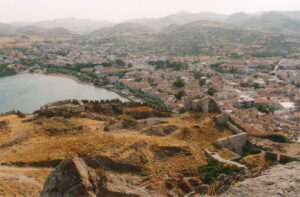
Myrina, the capital of Lemnos island in the northern Aegean, is a town where history, architecture, and everyday island life blend into a uniquely harmonious whole. Nestled between two natural bays and watched over by a dramatic volcanic rock crowned with a medieval castle, Myrina exudes a calm yet vibrant charm. Its beauty does not come from grand monuments alone, but from the subtle interplay between neoclassical elegance and deeply rooted local traditions. Walking through its streets, you sense a place that has grown organically over centuries, yet still respects its past.
At the heart of Myrina’s character is its distinctive architecture. On one side, you find stately neoclassical mansions with symmetrical facades, ornate balconies, and large windows that speak of a time when maritime trade brought prosperity and cosmopolitan influences to the island. These buildings often line the waterfront or occupy prominent corners, giving the town a dignified, almost aristocratic air. Their pastel colors, decorative cornices, and tall doors create a feeling of space and openness, reflecting the optimism of the era in which they were built.
Interwoven with these neoclassical structures are the traditional houses of Lemnos, more modest in scale but rich in authenticity. These dwellings, often built from local stone and topped with red-tiled roofs, follow the gentle slopes of the town’s hills and narrow lanes. Their architecture is practical and human-centered: thick walls for insulation, small courtyards for privacy and shade, and simple, functional layouts suited to island life. Many still retain wooden shutters, hand-crafted doors, and small balconies where everyday life unfolds quietly, from morning coffee to evening conversations.
What makes Myrina particularly captivating is the way these two architectural worlds coexist without clashing. The neoclassical mansions do not overshadow the traditional homes; instead, they complement them, forming a layered urban landscape. Modern interventions, for the most part, respect the town’s established scale and style, allowing Myrina’s skyline to remain gentle and cohesive. This balance creates a sense of continuity, as if the town has simply added chapters to its story rather than rewriting it.
The town’s setting amplifies this architectural harmony. Myrina stretches around two main bays: the Roman Shore and the Turkish Shore, each with its own character but both framed by elegant facades and seaside promenades. Fishing boats, small yachts, and traditional caiques rest in the calm waters, reflecting the buildings like a natural mirror. The presence of the sea softens the architectural lines and adds a constantly changing play of light, from the golden hues of sunrise to the deep blues and purples of evening.
Dominating everything is the imposing castle of Myrina, perched on a rugged rocky peninsula that juts into the Aegean. Its stone walls and ruins stand in contrast to the more refined town below, yet visually they belong together. The castle not only anchors the landscape but also serves as a reminder of the town’s strategic importance through the centuries. From its heights, the view reveals how the old and the new, the formal and the vernacular, come together to form the living tapestry of Myrina.
Despite the architectural diversity, Myrina has managed to remain loyal to local culture and traditions. Many of the traditional dwellings are still inhabited by families who maintain age-old customs in their daily lives. You can see it in the small gardens filled with seasonal flowers and herbs, in the stone-paved alleys where children still play, and in the way doors are left slightly open in the summer, allowing the sounds of conversation and clinking dishes to drift into the street. The architecture is not just a backdrop; it is actively used and cherished.
Public spaces in Myrina further reflect this connection between built environment and community life. Small squares, often shaded by trees or framed by old houses and cafés, act as social hubs where locals gather. These squares do not feel artificially planned; they seem to have emerged naturally where people wanted to meet, talk, and rest. Around them, cafés, tavernas, and small shops occupy ground floors of both neoclassical and traditional buildings, preserving the mixed-use character that keeps the town lively throughout the day.
Religious architecture adds another layer to Myrina’s identity. Churches with simple yet dignified facades, tiled roofs, and modest bell towers are scattered through the town. They are rarely monumental, but they stand as quiet focal points for the surrounding neighborhoods. Their interiors, often adorned with icons and candlelight, contrast with the bright Aegean light outside, creating spaces for reflection amid the rhythms of daily life. This spiritual dimension is woven seamlessly into the town’s architectural fabric.
In recent decades, tourism has grown, yet Myrina has largely avoided the kind of overdevelopment that has altered other island towns. Many of the neoclassical mansions have been restored with respect for their original features, sometimes converted into guesthouses or small boutique hotels. Traditional houses may have modern comforts inside, but their exteriors typically retain historic details. This careful adaptation allows the town to welcome visitors while preserving its authentic face.
The materials used in Myrina’s buildings also contribute to its sense of place. Local stone, wood, and clay tiles create a palette that feels rooted in the island’s geology and climate. The soft, earthy colors, combined with the bright whites and gentle pastels of neoclassical facades, ensure that nothing feels harsh or out of place. When the strong Aegean light falls on these surfaces, it enhances their textures and brings out subtle variations, turning even a quiet residential street into a visually rich scene.
Life in Myrina unfolds in close dialogue with this architectural environment. In the morning, sunlight filters through shutters of traditional dwellings and across the balconies of neoclassical homes. By midday, the narrow streets provide welcome shade, guiding residents and visitors alike toward cool courtyards or seaside cafés. In the evening, as the sky turns orange and purple, the façades take on warmer tones, and the lit windows and streetlamps give the town a softly theatrical atmosphere.
For the visitor, Myrina offers more than picturesque views; it offers a sense of intimacy and authenticity that is increasingly rare. You can wander from the seafront promenade into the maze of older neighborhoods within minutes, experiencing both the openness of the harbor and the coziness of hidden backstreets. At every turn, the architecture tells a story of commerce and seafaring, of family life and religious devotion, of adaptation to winds, light, and seasons.
In essence, Myrina’s beauty lies in its harmony. Neoclassical buildings provide grace and grandeur, while traditional dwellings ground the town in its local culture and everyday reality. The result is not a museum-like preservation but a living, evolving place where the past informs the present. Set against the dramatic backdrop of its castle and the gentle embrace of the Aegean Sea, Myrina stands as a compelling example of how architecture, landscape, and community can come together to form a town that is both uniquely characteristic and deeply welcoming.
In this way, Myrina is not only a beautiful town of Lemnos but also a quiet lesson in balance: between old and new, elegance and simplicity, heritage and modern life.